
Heavy-Duty Structural Protection: A Technical Guide to FloorScreed EP

Industrial concrete or steel structures are subjected to very harsh mechanical stresses, chemical attack, impacts and structural abrasion all the time. Typical floor coatings and paints do not perform well under these extreme operating conditions because they have a low film build, are subject to high solvent evaporation shrinkage or have a weak tensile bond.

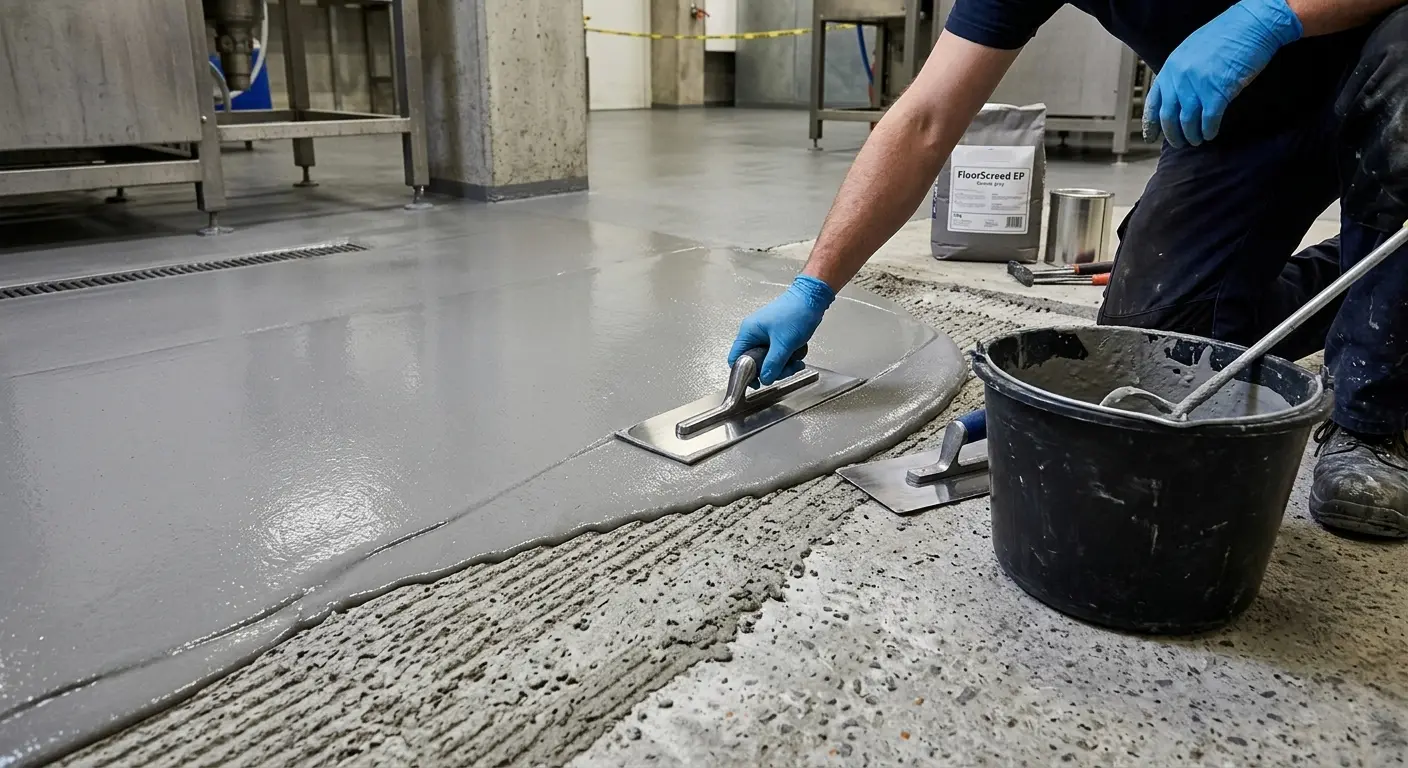
High build resinous screeds are designed to form a thick, continuous and protective layer over a susceptible substrate to ensure long term protection. FloorScreed EP is a high performing, 100% solid, three-component epoxy floor screed and coating system designed to provide protection to concrete and steel against physical, chemical and environmental attack.
Technical Performance Matrix

FloorScreed® EP’s 100% solids formulation eliminates solvent evaporation during cure, resulting in zero volatile organic compound (VOC) shrinkage and superior dimensional stability.

Technical Property Value / Specification Engineering Significance
System Chemistry 3-Component Epoxy (Resin, Hardener & Aggregates/Filler) High cross-linking density with exceptional structural mass.
Volatile Content 100% Solids Very low shrinkage, ensuring dimensional stability and long-term bond retention.
Compressive Strength 80 N/mm² Exceeds conventional concrete strength and supports heavy vehicular traffic and industrial equipment.
Flexural Strength 30 N/mm² High resistance to dynamic loading, thermal movement and bending stresses.
Tensile Strength 10 N/mm² Resists shear stresses and minimizes internal cracking under severe mechanical wear.
Pot Life 30–60 Minutes Provides adequate working time for mixing, trowelling and compaction.
Recoat Window Maximum 12 Hours Ensures optimum inter-coat adhesion and cross-linking.
Curing Time Light Traffic: 24 Hours
Full Traffic: 48 Hours
Minimizes facility downtime and enables faster commissioning.
Coverage & Density 2 kg/m²/mm thickness Provides predictable material consumption for high-build flooring applications.
Color Options Neutral, Yellow, Silver Gray, Green, Sky Blue, Cream Supports visual zoning, safety pathways and architectural aesthetics.
Key Performance Advantages
  1. Superior Mechanical Strength

Capable of achieving compressive strength up to 80 N/mm² and flexural strength of 30 N/mm², FloorScreed EP does not crack or spall when subjected to heavy equipment impact, steel-wheeled trolley movement, or forklift traffic.

  1. Broad Chemical & Abrasion Resistance

Designed to withstand industrial oils, fuels, water treatment chemicals and a variety of corrosive agents. It has excellent abrasion resistance, which helps to resist surface dusting and mechanical erosion of concrete substrates.

  1. Dimensional Stability via 100% Solids Technology

As there are no solvents in the system, it shrinks minimally during the cross-linking process. This allows high build screeds to be retained within their dimensions and free from the occurrence of internal shear stresses which can lead to edge curling or micro delamination.

Primary Application Sectors

FloorScreed® EP is engineered for heavy-duty civil infrastructure, marine, and industrial applications:

  • Water Infrastructure & Treatment: Sewage and wastewater treatment plants, water reservoirs, potable water storage tanks, and dams/aquariums.

  • Marine & Coastal Structures: Docks, jetties, marine structures, and splash zones exposed to salt water and wave erosion.

  • Transportation & Infrastructure: Bridge decks, tunnels, hydroelectric/power generation stations, parking slabs, and driveways.

  • Industrial & Architectural Facilities: Heavy engineering shop floors, concrete walls, patios, and exposed roofs.

Substrate Preparation & Application Protocol
  1. Substrate Preparation: Concrete or steel surfaces must be completely clean, dry, and free of laitance, rust, oil, and loose contaminants. Sandblasting is the most effective surface preparation method. Where sandblasting is unfeasible, scarifying, diamond grinding, or vigorous wire-brushing with coarse emery paper must be performed. Solvent degreasing with acetone, xylene, or toluene should be carried out to remove oils.

  2. Priming: A compatible epoxy primer is applied to the clean substrate to ensure thorough surface wetting and maximum adhesion.

  3. Mixing Sequence: Mix Component A (resin) and Component B (hardener) thoroughly using a low-speed mechanical mixer or planetary mixer. Gradually add Component C (graded filler aggregate) into the liquid mix until a homogeneous mortar consistency is achieved.

  4. Placement: Apply the mixed FloorScreed EP over the wet primer using a steel trowel to the desired thickness, ensuring compact finishing to eliminate air voids.

  5. Curing & Tool Cleaning: Clean all mixing gear and metal tools immediately after use using toluene, xylene, or acetone before the epoxy matrix hardens. Allow 24 hours for light foot traffic and 48 hours for full operational loads.

Similar Posts

Leave a Reply

Your email address will not be published. Required fields are marked *