
The Engineering Case for Polyurethane Systems in Modern Car Parking Facilities
In contemporary residential, commercial, and mixed-use developments, parking decksoperate under continuous mechanical stress, dynamic tire friction, chemical spillage (oils, fuels, and battery acids), moisture exposure, and thermal cycling. Selecting the right flooring material is no longer a purely cosmetic choice; it is a critical structural decision. When evaluated through technical performance, crack-bridging capability, and lifecycle economics, Polyurethane (PU) car parking systems consistently outperform rigid resin alternatives.
Why Standard Rigid Flooring Fails in Parking Structures
Traditional rigid flooring systems such as epoxy coatings and vitrified tiles provide high compressive strength but lack the flexibility required for parking structures. Continuous substrate movement, heavy vehicular loads, and thermal expansion and contraction often lead to cracking, delamination, and joint damage. In addition, inadequate waterproofing allows moisture and chloride ingress, accelerating reinforcement corrosion and reducing the service life of the concrete structure.
Step-by-Step Architecture of a High-Performance PU Parking System
A robust polyurethane car parking system is not a single paint coat, but an engineered multi-layer assembly designed for distinct physical functions:
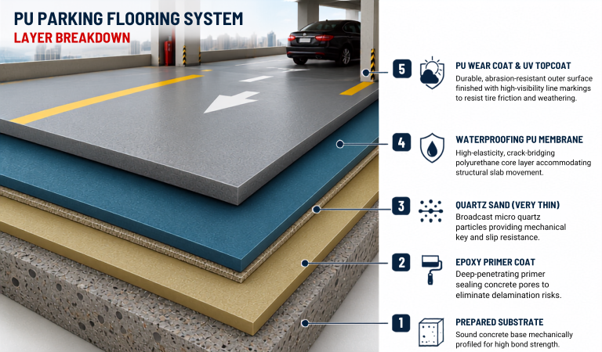
Substrate Preparation & Concrete Repair: All cracks, honeycombs, and weak zones are repaired, followed by mechanical surface profiling (shot-blasting or grinding) to ensure optimal mechanical keying.
Penetrating Primer Coat: Low-viscosity epoxy or polyurethane primers (such as FloorPrime EP5104) deeply penetrate concrete pores, sealing the substrate and maximizing interlayer adhesion.
Quartz Sprinkle / Filler Layer: Graded broadcasting sand (Oxidefill) is broadcast into the wet primer/base layer to enhance load-bearing capacity, build system thickness, and create a slip-resistant texture.
Flexible Waterproofing PU Membrane: Acting as the heart of the system, this elastomeric layer provides crack-bridging capabilities, moving synchronously with the concrete slab to prevent water ingress in basements and podium decks.
Polyurethane Wear Coat: Formulated to withstand heavy daily vehicle traffic, turning shear stresses, and intense tire friction.
UV-Resistant Aliphatic Topcoat: Applied primarily on exposed parking decks and ramps to prevent solar degradation, chalking, and color fading.
Traffic Markings: High-build thermoplastic or resin-based striping paints (DeckCoat LineMaker) delineate parking bays, drive lanes, and pedestrian walkways with long-term abrasion resistance.
Lifecycle Economics and Long-Term Value
While initial material and installation standards for multi-layer polyurethane systems require careful budgeting, their long-term maintenance economics are unmatched. By preventing moisture ingress, stopping carbonation, and eliminating recurring patch repairs, a properly specified PU parking system preserves structural integrity, enhances property valuation, and delivers a clean, professional environment for asset owners and visitors alike.